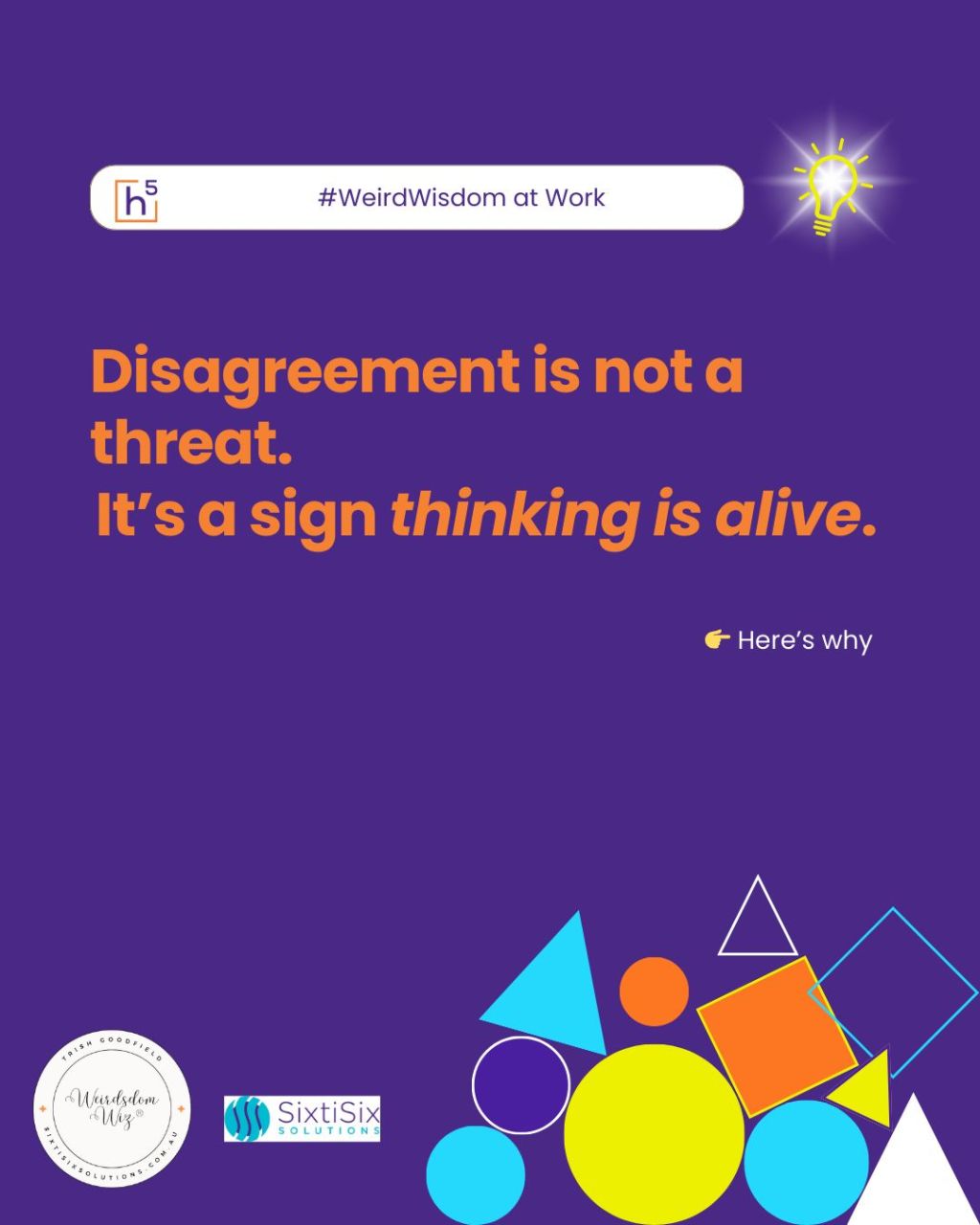
Most teams have an unofficial policy on disagreement. It is rarely written down, rarely discussed, and rarely intentional. But it shapes everything. You can feel it in the way conversations accelerate past a point of tension, in the silence that follows when someone raises an uncomfortable view, in the speed with which a room finds consensus when the real work of exploring an idea hasn’t yet begun.
In many teams, disagreement has been filed under things to manage rather than things to use. And that instinct, however understandable, is costing you more than you realise.
What Disagreement Is Actually Signalling
When people disagree, something important is happening: they are thinking. They are bringing a different read of the situation, a different set of experiences, a different sense of what matters or what the risks are. That difference is not a problem to hide. It is data. It is the raw material from which better decisions are made, if the conditions exist to work with it rather than around it.
When you treat disagreement as disruption, you optimise for comfort. Meetings feel productive because they are efficient. Decisions get made quickly. Harmony is preserved. But underneath that surface, blind spots go unexamined, assumptions harden into certainties, and risks that someone in the room could see clearly never make it into the conversation. The cost doesn’t always show up immediately. But it shows up.
When you treat disagreement as signal, by contrast, you move differently. You slow down in the places where the room diverges, rather than speeding past. You get curious about why two capable people are seeing the same situation so differently. You understand that the friction of competing perspectives, when approached thoughtfully, is where the most useful thinking happens.
Why This Matters for Diversity of Thought
This is where diversity of thought either delivers on its promise or fails to. The research on teams with Diversity of Thought is compelling: they identify risk faster, generate more creative solutions, and make better decisions under complexity. But that potential only converts to performance when your team has a genuine relationship with disagreement.
Here is the uncomfortable reality. You can have a team full of people who think differently, with varied backgrounds, disciplines, and perspectives, and still produce remarkably uniform thinking, if your culture believes that agreement is safer than honesty. Diverse perspectives don’t automatically surface. They surface when people believe it is worth the risk of raising them.
This is what Weird Wisdom® at Work is built around. Engaging difference is not a passive act. It requires you to understand that disagreement is not the opposite of collaboration, it is collaboration working as it should. It requires you to create the conditions where a perspective that cuts against the grain is treated as a contribution rather than a complication. And it requires the willingness to sit in the discomfort of genuinely competing ideas long enough for something better to emerge.
What You Can Do Differently
If you want your team to develop a healthier relationship with disagreement, it starts with how you respond to it when it surfaces.
When someone pushes back on a direction the group seems settled on, resist the pull toward resolution. Get curious instead. Ask what they are seeing that others might not be. Treat their hesitation as information worth exploring rather than an obstacle to moving forward. That single shift, from managing disagreement to investigating it, changes what people believe is possible in your team’s conversations.
When a meeting reaches consensus quickly, make it a habit to pause and ask whether the agreement is real or just comfortable. Invite the quieter people in the room to share where they are not quite convinced. Create just enough friction to ensure that the decision being made is a genuine one, not simply the path of least resistance.
And when disagreement surfaces ideas that turn out to be right, ones that caught a flaw in the plan or opened up a better direction, name that. Make it visible that the discomfort was worth it. Over time, this builds something genuinely valuable: a team that understands its best thinking doesn’t happen in spite of disagreement, but because of it.
The Stronger Team on the Other Side
Avoiding disagreement might feel like it protects your team’s cohesion. In practice, it protects something far more fragile: the appearance of cohesion. Real resilience comes not from the absence of tension but from your team’s ability to work through it and come out with something stronger on the other side.
When you embrace disagreement with curiosity rather than discomfort, you don’t just make better decisions. You build the kind of trust that only comes from having genuinely navigated hard conversations together. Your team becomes harder to rattle, because you’ve already practised staying steady when things get uncomfortable.
That kind of collaboration doesn’t happen by accident. It happens because you decided that harmony wasn’t the goal. Honest, rigorous, generative thinking was. And that decision showed up not in a policy, but in how you responded the next time someone in the room saw it differently.


Leave a Reply