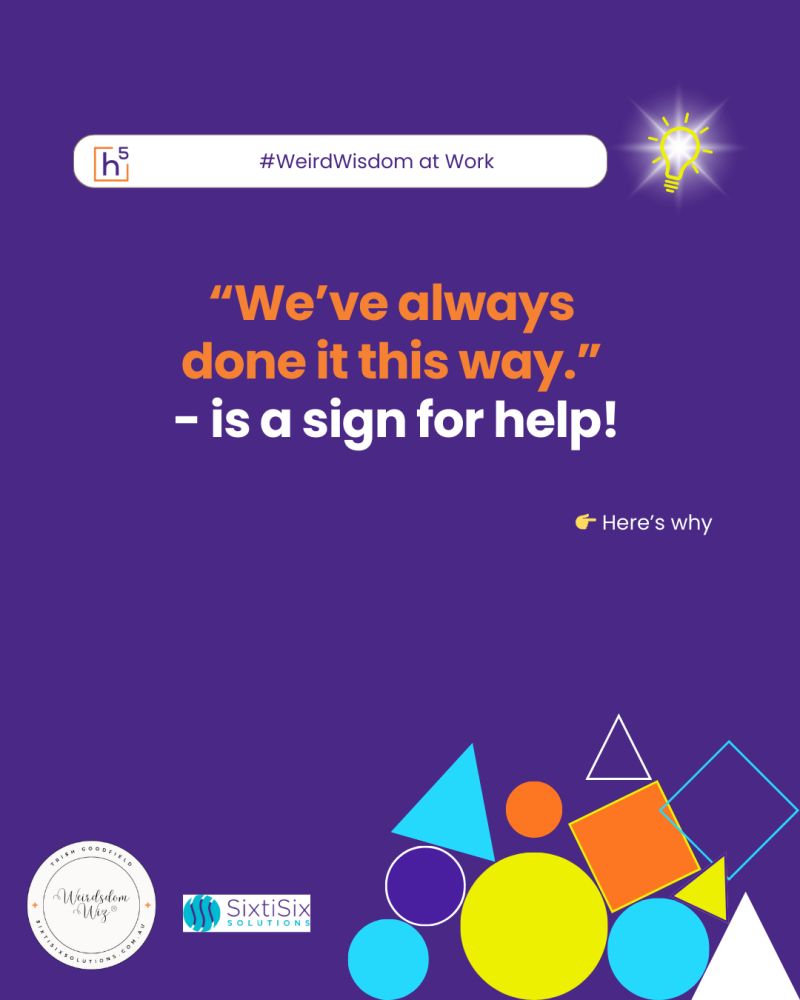
We’ve always done it this way is office code for help us. If you hear this, it is not a sign of confidence, it is a silent plea for someone to think.
This matters for Weird Wisdom® at Work because following tradition without thinking keeps mistakes alive and progress stalled. You can step in by asking the questions no one else wants to ask, pointing out flaws in the way you have always done it, and offering ideas that actually move things forward.
Your perspective exposes gaps, stops repeated errors, and forces the team to see options they are ignoring. When you translate we have always done it this way into actual solutions, you turn desperate habit into real work getting done and maybe make the office a little less boring.
You will hear that phrase more often than you expect. It tends to appear when someone suggests a change, challenges a process, or asks why something is done a certain way. On the surface it can sound steady and reassuring, as if the existing method must be right simply because it has existed for a long time. Yet when you listen closely, you may notice something else underneath. Habit. Uncertainty. Sometimes even quiet frustration. Those words can signal that a routine has been repeated so often that no one has stopped to examine whether it still makes sense.
Routine itself is not the problem. Some systems work well precisely because they have been tested and refined. You do not need to question everything just for the sake of it. The issue begins when repetition replaces reasoning. If you keep following a process without understanding why it exists, you lose the ability to see when it stops serving its purpose. Circumstances change. Tools improve. Expectations shift. What worked once may now be slowing you down. If no one questions it, the process continues anyway, even when it no longer fits the reality you are working in.
You might already notice this happening. You might sense that something feels inefficient or outdated. You might see steps that no longer add value or tasks that could be handled differently. Often you will not be the only one who notices. Others may see it too but hesitate to speak. Raising a concern can feel risky, especially if you are unsure how it will be received. You might wonder whether you will be seen as difficult or disruptive. That hesitation is common, but it is also the reason outdated habits survive as long as they do.
When you choose to speak, you do not have to do it dramatically. You do not have to declare that everything is wrong. Thoughtful curiosity is usually far more effective. You can ask what problem the process was originally designed to solve. You can ask whether it still solves it. You can ask whether anyone has tested an alternative. Questions like these shift the conversation. They move you and the people around you from automatic repetition into active thinking. Once that shift happens, improvement becomes possible.
You may worry that raising questions will create tension. In reality, you are often preventing bigger tension later. When outdated methods go unchallenged, problems tend to grow quietly. By the time they are obvious, they are harder to fix. When you point something out early, you give yourself and your team the chance to adjust before the issue becomes costly or urgent. That is not disruption. That is foresight.
You also create opportunity. The moment you question a routine, you open space for better ideas. You might suggest a simpler step. You might notice something that can be removed. You might connect two tasks that could be combined. Small adjustments like these can transform how work flows. They save time, reduce frustration, and improve results without requiring massive change. Innovation does not always look dramatic. Often it looks like you noticing something everyone else overlooked.
When you do this consistently, you influence more than a single process. You shape how people around you think. You signal that it is safe to be thoughtful instead of automatic. You show that improvement is welcome. Others begin to contribute their observations too. Conversations become more curious. Decisions become more informed. The environment becomes one where thinking is expected rather than optional.
It is worth remembering that progress rarely begins with authority. It usually begins with attention. You do not need a title to notice something that could work better. You do not need permission to ask a question that brings clarity. You only need the willingness to trust what you see and say it out loud. Many of the changes that improve workplaces start with someone who decided not to ignore a thought that could make things better.
Tradition can be useful when you understand it. It becomes limiting when you follow it blindly. When you hear that familiar phrase, treat it as an invitation. It is an opening for you to think, to ask, and to improve. What sounds like certainty is often just routine waiting for someone like you to question it.
 Trish's Blog
Leave a comment