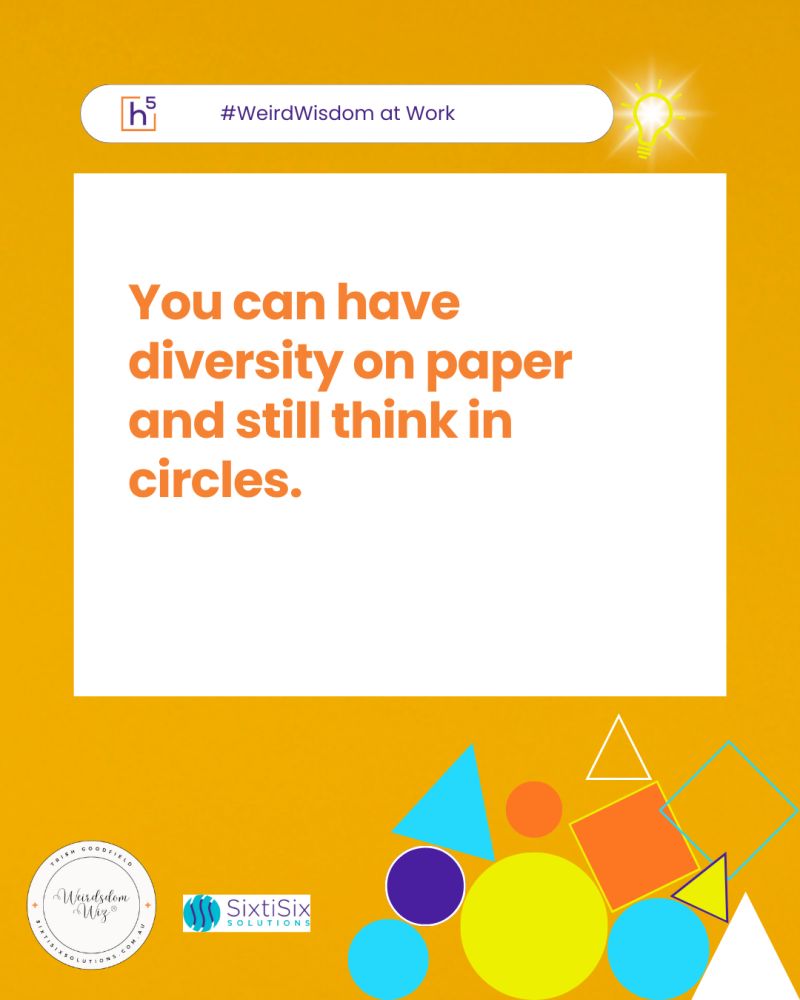
Real diversity starts with how people think, not how they look. If you chase optics, you miss the point. You can have all the visible variety in the world and still end up with the same recycled ideas.
This matters for Weird Wisdom® at Work because your thinking is what drives real results. Real impact comes when you bring your unfiltered thinking, challenge assumptions, and raise perspectives no one else is noticing. When you contribute openly, you force better decisions, reveal blind spots, and help the team see what it would otherwise ignore.
Diversity of Thought is not demographic diversity. It is about the ideas you bring, the questions you ask, and the way you push the work forward.
Many organisations talk about diversity as if it were a visual checklist. They count representation, publish statistics, and celebrate numbers. Those steps can matter, but they are not the finish line. They are the starting point. When attention stops at appearances, diversity becomes cosmetic rather than functional. It looks impressive from the outside but does not necessarily change how decisions are made or how problems are solved.
Diversity of Thought is different. It is not about who is present in the room. It is about what is present in the conversation. You can assemble a group of people with varied backgrounds and still hear only one type of thinking if everyone feels pressure to agree. You can also have a group that appears similar on the surface yet produces powerful innovation because individuals feel safe enough to contribute distinct perspectives. The visible layer does not guarantee the cognitive layer. That part depends on culture.
Optics are appealing because they are easy to measure. They produce quick evidence that something has been done. Thinking diversity is harder to track. It requires attention to behaviour, interaction, and decision making. It asks leaders and teams to notice who speaks, who hesitates, whose ideas get explored, and whose ideas get ignored. It demands reflection rather than assumption. That effort is precisely why it creates deeper impact.
Unfiltered thinking is often misunderstood. It does not mean careless speaking or constant disagreement. It means thoughtful contribution that is honest rather than edited for approval. Many people filter their ideas before sharing them. They soften opinions. They remove anything that might be seen as too different. They wait to see what others say first. This filtering habit is understandable, especially in environments where standing out has previously been punished or dismissed. Yet every time someone edits out what makes their perspective unique, the team loses access to information it does not already have.
Challenging assumptions is one of the most valuable contributions a person can make. Assumptions shape decisions long before those decisions are visible. They influence what options are considered, what risks are ignored, and what possibilities are dismissed. When someone questions an assumption, they do not slow progress. They refine it. They ensure that action is based on reality rather than habit. That kind of challenge is not disruption. It is due diligence.
Teams that welcome this kind of thinking tend to make stronger choices. They identify weak spots earlier. They notice patterns sooner. They avoid costly missteps because someone was willing to point out what others overlooked. These benefits do not come from agreement. They come from exploration. Exploration requires multiple perspectives interacting with each other, testing each other, and strengthening each other. It is an active process, not a passive one.
There is also a responsibility that comes with valuing thinking diversity. It is not enough to say you want it. You have to create conditions where it can actually happen. That means responding constructively when someone offers a different view. It means asking follow up questions instead of shutting the idea down. It means rewarding insight, not just speed. When people see that their thinking is taken seriously, they are more likely to keep contributing. When they see it dismissed, they quickly learn to stay silent.
Silence is often mistaken for agreement. In reality it can signal hesitation, uncertainty, or caution. A room can look aligned while several people inside it are unconvinced. If those unspoken perspectives remain hidden, decisions are made without them. That limits accuracy and reduces the chance of finding better options. Inviting people to speak is not just polite. It is strategic. It expands the range of information available before action is taken.
Another overlooked aspect is that Diversity of Thought is dynamic. It grows as people learn, experience new situations, and encounter different viewpoints. Encouraging it is not a one time initiative. It is an ongoing practice. Each conversation is an opportunity to either widen or narrow the range of thought in the room. Each response either signals openness or signals caution. Over time those signals shape whether people bring their full perspective or only a safe portion of it.
Real diversity shows up in decisions, not just in headcounts. It is visible when a team considers options others might have missed. It is evident when discussions include thoughtful challenge rather than automatic agreement. It is clear when outcomes reflect insight that could only have emerged from multiple ways of thinking working together.
If the goal is progress, then appearances alone will never be enough. Progress depends on contribution. Contribution depends on people trusting that their perspective matters. When individuals bring their real thinking into the room, the room becomes smarter. When many people do that consistently, the results speak for themselves.
 Trish's Blog
Leave a comment