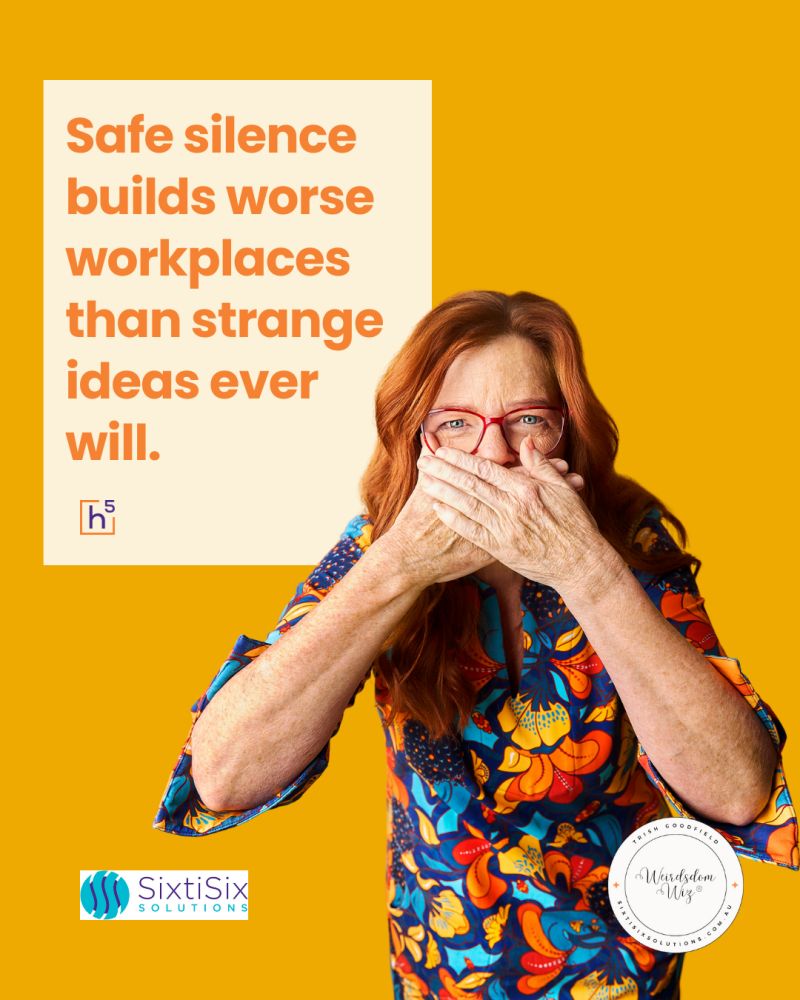
Strange ideas build better workplaces than safe silence ever will.
This matters for Weird Wisdom® and Diversity of Thought because polite agreement is often the most dangerous habit a team can develop.
If you stay quiet to avoid rocking the boat, you are part of the problem. Mistakes repeat, opportunities slip away, and the team gets stuck in the same patterns. Silence feels harmless in the moment. It feels cooperative. It feels professional. In reality, it is often a slow leak of potential. Every unspoken question, every withheld observation, every instinct you dismiss instead of voicing becomes fuel for stagnation.
Most workplaces do not suffer from a lack of intelligence. They suffer from a lack of interruption. People see things. They notice gaps. They sense risks. They spot possibilities. Yet many hold back because speaking up carries social risk. They worry about being wrong. They worry about being seen as difficult. They worry about disrupting momentum. So they stay quiet and call it diplomacy. The trouble is that silence protects comfort, not progress.
Patterns are powerful. Once a team has done something the same way for long enough, that way starts to feel like the only way. Processes become routine. Routines become unquestioned. Unquestioned habits become invisible rules. At that point, even obvious improvements can feel threatening because they challenge what everyone has agreed, without saying so, to accept. Strange ideas are often the first signal that a pattern needs updating. They stand out because they do not match what already exists.
You can change that by speaking up, questioning the obvious, and forcing the team to confront what everyone else is ignoring. This does not require aggression or theatrics. It requires clarity and courage. A well placed question can do more than a long speech. Why are we doing it this way. What are we assuming. What have we not considered. Questions like these interrupt autopilot thinking. They bring hidden assumptions into the open where they can be tested instead of obeyed.
Your thinking challenges routines, exposes weak spots, and drives results that would not happen otherwise. You do not need permission to make an impact. Waiting for permission is one of the most reliable ways to ensure nothing changes. Influence rarely begins with authority. It begins with observation and the willingness to voice what you see. Many of the shifts that transform teams start as a single comment that someone almost kept to themselves.
It is important to recognize that different thinkers often deliver value in ways that are not loud or immediate. Some people process internally before they speak. Some notice patterns others overlook. Some instinctively test ideas for flaws. These contributions may not look dramatic, but they are essential. When teams overlook them, they trade depth for speed and certainty for assumption. When teams invite them, they gain insight that protects them from costly blind spots.
There is also a collective responsibility here. Cultures are shaped not only by leaders but by what groups tolerate. If a team dismisses unusual suggestions, people learn quickly to stop offering them. If a team responds with curiosity, people learn that original thinking is welcome. The difference between those two environments is not talent. It is response. One response shuts thinking down. The other multiplies it.
Strange ideas are often treated as risky because they disrupt familiarity. Yet familiarity is not the same as effectiveness. Many ineffective systems survive simply because no one challenges them. The moment someone does, the weakness becomes visible. That visibility can feel uncomfortable, but discomfort is not a sign of failure. It is a sign that something real is being examined instead of avoided.
Step in, speak out, and force the team to think differently. That does not mean opposing everything. It means contributing something. It means trusting that your perspective exists for a reason. It means recognizing that progress depends on people who are willing to notice what others overlook and say what others hesitate to say. Silence maintains the status quo. Thoughtful challenge improves it.
There is a practical truth that often gets missed. Innovation is rarely the result of perfect agreement. It is the result of tension handled well. When ideas rub against each other, they sharpen. When perspectives collide respectfully, they expand. When someone introduces a thought that does not fit, the group has a choice. Dismiss it and stay the same. Explore it and possibly become better.
That is how real work gets done. Not through endless agreement, not through safe repetition, but through contribution that shifts the direction of thinking. The next time you notice something that does not quite add up, resist the urge to swallow it. That observation might be exactly what the room needs.
 Trish's Blog
Leave a comment